Using data aggregated from 2,179 Google Ads accounts we have been able to track how much Google Shopping budget has spent via Performance Max, Smart Shopping and Standard Shopping.
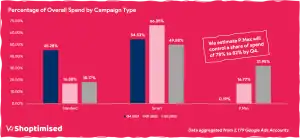
Spend in Performance Max campaigns has almost doubled when comparing Quarter 2, 2022 (31.95%) against Quarter 1, 2022 (16.77%). It appears that most of the Performance Max growth is coming from retailers and agencies switching from Smart Shopping which could be in part driven by the Google Migration process.
Standard Shopping also saw a small increase in spend during Quarter 2 as agencies and retailers most likely sought more control and transparency.
Whilst Performance Max delivered a better ROAS and higher Average Order Value than Standard or Smart Shopping during Quarter 1, 2022 results dropped in Quarter 2, 2022 with Performance Max and Smart Shopping having an identical ROAS (we double, and triple checked that!) and an almost identical Average Order Value.

Both Smart and Performance Max continue to outperform Standard Shopping, but it is concerning to see Performance Max results dropping as more retailers and agencies start switching over.
We wondered whether adoption was causing Performance Max results to drop or is it just down to how it’s being set up? It’s difficult to answer either conclusively and the adoption questions will require a lot more time to answer conclusively. But we did take a deeper dive into the use of Target ROAS within Performance Max campaigns.

You can see from the results that most Performance Max campaigns are utilising or being hampered by (depending on which camp you sit in) a Target ROAS. Performance Max campaigns that did not use a Target ROAS achieved a higher ROAS and a better Average Order Value.
We know from our own testing that utilising a Target ROAS can restrict your reach and reduce your revenue. In a lot of instances, Target ROAS is not used correctly or updated and changed far too frequently which constantly resets your learning period. You read more about that here.
Q: Is the best approach to managing Performance Max to simply remove the Target ROAS settings?
For some agencies and retailers, that would be a very uncomfortable thought and it’s not something we would suggest unless you had control over your product feed so you could build and utilise performance data.
We developed a solution for this approach 4 years ago which we call Performance Rules. Our Performance Rules let you pull data from your Google Shopping and utilise that data to create better campaign structures, one example of such is below…
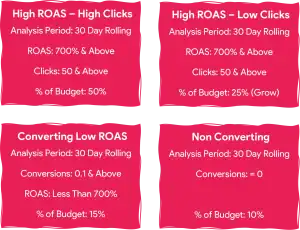
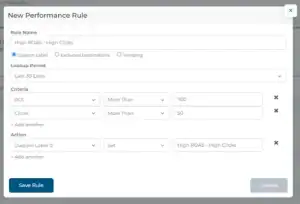
These campaign structures utilise a theory by Google called Business Objectives and are more focused on working to complement your business goals as opposed to just setting one Target ROAS and seeing what you get back.
Whilst the above is just one example, there are many ways you can structure campaigns based on the data you input and utilise within your Product Feed. In addition to Google Shopping performance data, the Cost of Goods Sold attribute can help you to create profit margins.
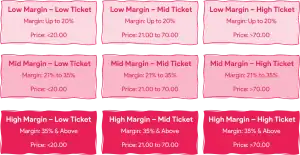
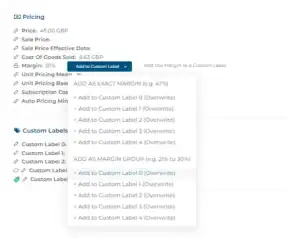
The newer Sell on Google Quantity attribute can be utilised to pass stock data to ensure campaigns either focus on well stocked products or this information can be combined with other attributes such as Size or Colour to exclude low stock product ranges.
When more data is utilised at a Product Feed level to enhance your campaign strategy, it gives you more control over Performance Campaigns and the ability to step away from using Target ROAS settings.
Other campaign factors within Performance Max such Ad Assets and Audiences can have an impact too. At Shoptimised we prefer to use neither, we have found this approach keeps 97% of the Performance Max traffic focused on Shopping.
Once you add in Ad Assets, the amount of Search and Display traffic starts to increase. This means your brand traffic can be potentially pulled into Performance Max which will greatly improve results whilst the Display traffic will most likely lower results. But the combination of them both evens out and due to the lack of visibility, there is no way to know what traffic volume is going through Search and Display.
You can however, work out how much traffic is going through your Shopping Ads. Simply note the clicks, revenue, conversions etc of your Performance Max campaign(s).
Then go to Reports > Predefined Reports (Dimensions) > Shopping > MC ID and add into your columns, Conv Value, Conversions etc.
Now you can easily calculate the difference and understand how much of your traffic is going via Shopping.
The growth in Standard Shopping campaigns piqued our interest and we had one question we wanted to answer…
Q: How much of the Standard Shopping spend is managed under Manual CPC bidding vs automated bid strategies?
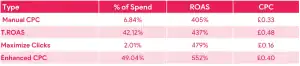
As you can see from the above, the answer is very little. It seems that we are all mostly happy to let Google either fully automate or at least partially automate (Enhanced CPC) our bidding, even with Standard Shopping campaigns.
If we then look at the spend across all 2,179 Google Ads accounts, 89.9% of the spend (exclude Manual CPC and Enhanced CPC) was utilising a fully automated Google Bid Strategy. Enhanced CPC made up 8.91% of the spend and Manual CPC bidding accounted for just 1.24%.

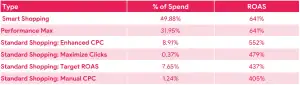
The data (so far) backs up what Google claim, that their automation can drive better results.
So, it begs the question, what is putting off the remaining 20% from moving over to Performance Max?
We think the answer must be due to a desire for greater transparency and search term data, something we would all love back please.
When it comes to managing your Google Shopping budgets in the run-up to Black Friday, the question looms large: should we go early, go all in on Black Friday itself, or reserve more budget for after the promotional period?It's a dilemma that keeps ecommerce managers awake at night. Commit too early and you risk burning through the budget before the main event. Wait for Black Friday and you might miss the early bird shoppers. Hold back for Cyber Monday and you could be left picking up scraps.
We analysed data from thousands of Google Shopping campaigns between 19th November and 8th December, breaking it down into six distinct periods. Here's what the numbers tell us – and how you can turn these insights into action for a winning Black Friday strategy.
Here's what most advertisers miss: This period was significantly under-invested last year, despite most Black Friday sales already being live and early shoppers actively hunting for deals. Why does this matter? Because consumer behaviour has shifted dramatically in recent years. Shoppers are savvier, more strategic, and increasingly aware that the ""best"" deals often appear before Black Friday itself. They're doing their research early, comparing prices, and many are ready to buy well ahead of the main event.
The data reveals something striking this window delivered the strongest Return on Ad Spend(ROAS), the lowest Cost per Click (CPC), and the third highest Average Order Value of the entire promotional period. Think about that for a moment: you're getting better returns, paying less per click, and customers are spending nearly as much as they do on Black Friday itself.
Your move: If strong ROAS is your priority, this is where you need to lean in. While competitors sleep on these early days, conserving their budgets for the ""big day,"" you have a golden opportunity to capture high-intent shoppers at a fraction of Friday's costs. Consider this your secret weapon the period where efficiency meets opportunity. Don't just maintain your usual budget during this window actively increase it. Test higher bids, expand your product coverage, and make sure you're visible when these early shoppers are making their purchasing decisions.
Let's be clear: the sheer volume of demand and revenue available on Black Friday remains unmatched. This is still the Super Bowl of ecommerce, and you absolutely need a healthy budget to cover the full 24-hour period. But here's the catch despite boasting the second highest Average Order Value, ROAS wasn't as strong as the preceding 10 days. Why? The surge in demand drives up competition in Product Listing Ads, which inevitably pushes Cost per Click higher. Every retailer and their dog is fighting for the same eyeballs, and Google's auction system responds accordingly. This doesn't mean Black Friday isn't worth it far from it. The total revenue opportunity is simply too large to ignore. But it does mean you need to be smarter about how you approach it.
Your move: Revenue attribution will be slow on the day itself, so manage your budget hourly. This isn't a ""set it and forget it"" day, you need to be actively monitoring performance throughout. Don't let your budget dry up at 3pm when there's a whole evening of shopping ahead.
Many retailers make the mistake of front-loading their budget, assuming the morning surge is where all the action happens. But shopping patterns on Black Friday are increasingly extending into the evening as people browse on their phones from the sofa after work. Monitor, adjust, and keep feeding the machine throughout the day. Consider setting up automated alerts for when you hit certain budget thresholds, so you can make informed decisions about whether to increase spend or let things coast.
Saturday often becomes the Cinderella of Black Friday weekend and not in a good way. It consistently underperforms, largely because budgets set high for Friday are left unchanged overnight. Here's what happens: retailers set aggressive budgets for Black Friday, the clock strikes midnight, and those budgets roll into Saturday without any adjustment. Meanwhile, consumer behaviour shifts dramatically.
With shoppers hitting the high street the day after Black Friday, online demand naturally dips (unless bad weather keeps people indoors). Physical stores are offering extended sales, the novelty of ""Black Friday"" has worn off slightly, and many
shoppers who were going to buy online have already done so."
Yet Cost per Click remains elevated from Friday's spike, creating a toxic combination that hammers your ROAS. You're paying premium prices for reduced demand – the worst of both worlds.
Your move: Don't sleepwalk through Saturday morning with Friday's budget. Pull back late Friday evening or first thing Saturday. Be ruthless about this – your ROAS will thank you. Set a calendar reminder for 11pm on Friday night, or even better, schedule budget changes in advance if your platform allows it. There's no shame in being conservative on Saturday – you can always increase budgets if you see performance
picking up, but clawing back wasted spend is impossible."
In recent years, Sunday has quietly become a dark horse, often outperforming even Cyber Monday. But there's a wild card in play: the weather.
With Black Friday falling on a payday again this year, mild weather could see shoppers flooding physical stores for extended weekend sales. Town centres and retail parks become destinations, with families making a day of it. When the sun's out, browsers are out. Poor weather? That's when online demand surges. Rainy Sundays create a captive audience of shoppers who were planning to go out but are now scrolling through deals from the comfort of home. This weather dependency makes Sunday one of the most unpredictable days of the promotional period, but also potentially one of the most lucrative if you can read the conditions right.
Your move: Watch the forecast religiously in the days leading up. If rain is predicted across major UK population centres, be ready to capture the spike in online traffic as shoppers stay home and shop from their sofas. If it's going to be sunny and mild, consider pulling back and saving your powder for Cyber Monday instead. The key here is flexibility. Have a plan for both scenarios and be prepared to execute on Saturday evening once the Sunday forecast becomes clearer.
Here's where the desk-bound shoppers take over. Traffic and conversions shift heavily towards desktop as people hunt for deals during work hours. While Cost per Click rises again, Average Order Value climbs too creating a positive impact on ROAS.
Cyber Monday has maintained its relevance precisely because it captures a different type of shopper in a different context. These are people who might have browsed on their phones over the weekend but want the bigger screen and better bandwidth of their office computer to make final decisions. They're comparing specifications, reading reviews in detail, and making considered purchases. There's also a psychological element at play – Cyber Monday feels like the "last chance" for many shoppers, creating urgency that drives conversions.
Your move: Position yourself to capture that crucial 9am to 5pm surge. This is office workers on lunch breaks and "strategic bathroom visits" make sure your campaigns are firing on all cylinders during business hours. Consider dayparting strategies that increase bids during working hours and reduce them outside this window. Your budget will go further, and you'll be matching your ad presence to when your audience is actually shopping. Also, think about your creative messaging and product focus. Desktop shoppers often have different purchase intent than mobile browsers they might be looking at higher-value items or products that require more detailed research.
Don't write off the post-Cyber Monday period just yet. As the frenzy subsides, Cost per Click begins to fall while demand levels stabilize. This drop in CPC positively impacts ROAS, even though Average Order Value typically decreases during this window. What's happening here is that the casual browsers and bargain hunters have made their purchases, but there's still a segment of shoppers who are either procrastinating, waiting for their payday to clear, or genuinely just getting around to their shopping now. The advertising landscape is also less crowded as competitors wind down their Black Friday campaigns and refocus on regular trading or Christmas campaigns.
Your move: This is where smart merchandising makes the difference. Focus on initiatives that drive up basket value – "buy one, get 20% off" promotions or strategic campaigns targeting higher price points can turn this cool-down period into a profitable extension of your Black Friday success. Consider bundle deals, cross-sell opportunities, or "complete the look" style merchandising. Since your Cost per Click is lower, you have more margin to work with – use it to encourage larger basket sizes rather than just chasing volume.
This is also an excellent time to retarget people who browsed during Black Friday but didn't convert. They've had time to think, the pressure of "limited time offers" has passed, and they might be ready to buy if you can give them a gentle nudge with the right offer.
Black Friday success isn't just about throwing money at Friday itself. The data shows the winners are those who invest early, manage budgets dynamically throughout the weekend, and stay strategic through the following week.
Think of the Black Friday period not as a single day but as a two-week campaign with distinct phases, each requiring different strategies and budget allocations. The retailers who understand this – who can be aggressive when efficiency is high, cautious when costs spike, and opportunistic when conditions favour online shopping – are the ones who'll come out ahead.
The opportunity is there. The data proves it. The question is: will you seize it, or will you follow the crowd and under-invest in the periods that matter most?
As we approach Q4, retailers start to gear up for the busiest period and begin increasing their investment in Google Ads, particularly Google Shopping Ads. In Q4 of 2022, Google Shopping Ads took the largest portion of spend and resulted in 65% of overall Google Ads spend. Data from Shoptimised.
Although Shopping Ads are growing every year and have evolved from Standard Shopping to Smart Shopping and now Performance Max, retailers still have a lot of questions about how to get their Shopping Ads more visibility.
This isn’t just a question clients put to their agencies. It is also a question we are commonly asked when speaking with agencies that subscribe to Shoptimised.
The Google Academy gives insight into the Shopping Ads algorithm and auction dynamics, including what goes into serving an ad.
Data Quality: This looks at the key components of Shopping and includes unique identifiers such as GTIN, title, brand, MPN and description. It also considers the quality of images in the feed and takes price into account.
Product Relevance: Product relevance works together with data quality, as the quality of the data also needs to be relevant to the product being advertised.
Predicted Click Through Rate: Expected Click Through Rate has been a factor in Quality Score on Search for a long time, and we now have confirmation that this is also a factor in the Shopping auction. Google looks at the historical data of your account and product feed, then predicts a click through rate. The more relevant your product, the better your predicted click through rate will be. More relevant data within your product feed will then increase your predicted click through rate over time. This leads to a better position in the Shopping results, which in turn leads to a better click through rate, and the cycle repeats itself.
Bid: The bid is often thought of as the key component of being shown in a Shopping auction, but it is just one of four key parts. The better optimised your product feed is, the higher your predicted click through rate will become, which results in you having to make a more modest bid. However, if you find yourself having to increase your bid, it could mean you have neglected the other key areas. When it comes to Performance Max, you’re not in control of the bid, but you can influence it via your campaign settings with bidding strategies such as Target ROAS. However, the higher you set your Target ROAS, the more Google will restrict traffic and products if it doesn’t predict you will achieve your Target ROAS in each auction. This is why it is imperative to get your data quality and product relevance right, as it has a direct impact on the Cost per Click you will potentially have. The lower your Cost per Click, the more likely Google is to serve more products, as your Target ROAS becomes easier to achieve.
Titles: Google listing title as one of the key attributes with a high impact on the auction is no surprise, as this, along with the image and price, is what is shown in Shopping results. Google is looking for rich keywords that have high search volume, but adding the brand, gender and age group to the titles gives more long-tail visibility, higher click through rates and conversion rates.
GTIN: Google uses GTINs as a unique product identifier. Products without a GTIN, particularly from well-known brands, can see a significant decrease in impressions or potential disapproval. If the GTIN isn’t in the correct format, this will also lead to a disapproval.
Product Type: This has no impact on your website. This is how you categorise your products and it displays as a breadcrumb trail in your Shopping feed. It has a high impact on the relevance of your product and is often neglected in non-optimised feeds.
Descriptions: Descriptions have a strong impact on onsite performance and product relevance. Descriptions should be unique and contain rich keywords in a structure that informs the user.
Google Product Category: Google Product Category attributes have a strong impact on relevance. Selecting the wrong Google Product Category can lead to low visibility for products, or cause them to show for incorrect search terms. This leads to a poor click through rate, which then impacts both your predicted click through rate and historical click through rate.
Other Attributes: Size, colour and gender don’t have as much of an impact as the other attributes within search terms. However, depending on the Google Product Category, some attributes are key. For Clothing & Accessories, size, gender, age group and colour are required, and will give warnings in Merchant Centre if they are not in the feed. These attributes also factor more into the filtering of the Google Shopping page. If a potential customer filters by a colour that you’re not passing in the colour attribute, you will vanish from the results.
To help improve data quality and product relevance, these are quick wins we commonly apply and that can potentially benefit all retailers.
1. Duplication of titles
The first check we complete in a feed is looking for duplicate titles. Clients who sell variants commonly have duplicated titles that are generally the name of the parent product. Adding in sizes, quantity and colour where available removes title duplication from the product feed. This gives focus on more long-tail, size, colour, material and pattern-specific searches, which are more likely to convert and improve bounce rate.
2. Building out Product Types
We often see just one product type added to a product, but expanding this to 4 to 5 levels of Product Type allows for better filtering of products within Google Shopping Ads campaigns and can double down on search terms. We can take a basic “Trainers” product type and change that to:
Mens > Trainers > Nike > Black > Size: 10
This can be done using simple rules in the Shoptimised platform.
3. Make sure your Google Product Categories are correct
Google is very good at predicting the correct Google Product Category when missing for common products like clothing, homeware and baby and toddler products. However, for more niche products, or products with titles that contain a common term for another product, Google can incorrectly categorise products.
Taking a look at how this all comes together in an auction, imagine three products: Product A, an optimised product with a below benchmark price. Product B, a well-optimised product with a benchmark price. Product C, a poorly optimised product with a below benchmark price.
We can see how this would be displayed in a Google search for the term “Mens size 9 blue Nike running trainers”. This is a long-tail term with a high chance of conversion if the auction is won. The customer knows exactly what they want, not the exact style, but they are looking for a specific type and colour of trainer.
Product B is the winner in this auction. The titles are well optimised, which is 80 to 85% responsible for the search results. The difference between option A and B is that option B has colour in the title, despite not being as well priced. This allowed it to be the most relevant product to the search and win the auction.
If we tweak the search term to “Mens cheap size 9 blue Nike running trainers”, Product A is the winner. The product is still well optimised and has pricing below the benchmark, just like option C. However, option C is poorly optimised, so it does not win the auction.
Getting your products to show in the right search results, at the right time, for the right cost, is just one part of the challenge. Being chosen once you’re there is the next.
Google recently shared data based on tests they carried out to find what influences customers when selecting a retailer from a Shopping Ad. Price and discount are the main drivers for shoppers, and with the biggest discount and sales period just around the corner, getting your price and discount strategy right can be make or break.
Next, shoppers are focused on the brand of the product they want and are less likely to be concerned about which retailer they buy it from. Studies show that a shopper will choose a lesser-known retailer for the same product if the price is right. Those decisions increased where another retailer offered both a better or same price, but delivery was simpler and free.
Make sure you consider all of these points and where you as a retailer can improve and influence these factors. These genuinely fall outside the remit of your PPC agency or in-house marketing department. They could be doing an amazing job in terms of feed optimisation and campaign management, but if you’re not competitive in these factors, performance can still suffer.
If you have created the perfect product feed, built the best campaign structure and created a pricing and discount model that makes you competitive, don’t fall over at the final hurdle.
After feed optimisations have been put into place, refresh your feed in Merchant Centre and check for warnings or disapprovals that can hamper your performance. These warnings will limit your visibility, lower your data quality and, in the worst-case scenario, could have your account suspended.
Inaccurate price or availability: The landing page does not match the price or availability in the Shopping feed. This can lead to an email from Google with a 30-day warning to fix the issue before suspension. Common reasons for this are recent price drops or the product going out of stock. If this is the case, a review can be quick, and turning on automatic updates for price and availability can prevent this matter occurring. Other reasons include currency updates depending on IP address, which can cause discrepancies in the feed and landing page, as Google will review a feed from their location. Using multi-currency URLs can prevent this.
Inaccurate shipping costs: If the shipping costs on your website change, make sure this is updated in the Shopping feed or in Google Merchant Centre. This is a preventable issue, but one that is often forgotten.
Invalid GTINs: These will result in a disapproval. GTINs are the barcode of the product and a unique identifier of the product. To solve this issue, either remove the incorrect GTIN or provide the correct one.
Limited performance due to missing GTINs: This carries a warning rather than a disapproval. This will only affect certain products. If other retailers have the GTIN for the product, then it is likely this warning will show if you do not have it.
Unavailable desktop or mobile landing page: This means the product in the feed has a broken URL to the landing page. Remove all old products from the Shopping feed if they no longer exist, and make sure to fetch your feed daily so the feed is up to date.
Incorrect value: identifier exists: Identifier exists has two options: yes or no. If you do not have two of the three identifiers, MPN, GTIN or Brand, this must be set to no. If you have at least two of the three, this should be set to yes.
Missing attribute: gender, age group, colour or size: If your product has a Google Product Category that begins with “Clothing & Accessories”, your products are recommended to have size, age group, gender and colour.
Promotional overlay on image: The product image must only show the product on a plain background with no logos or text overlay. Automatic image improvements can fix this issue, otherwise you will need to upload a new image.
Sexual interests in personalised advertising: Throughout October, we have seen more and more products get flagged for this issue. Google looks to be increasingly sensitive on this, with anything remotely sexual, or anything that can be interpreted as sexual in the description or title, potentially being flagged. Request a review if your products have been incorrectly flagged, or contact a Google rep if you have a lot of warnings.
Once you have cleared your warnings and disapprovals, your feed and Merchant Centre will be in the best possible shape for the busiest period of the year. The final step for success in this period is to be proactive with your promotions.
Make sure all promotions are set up in advance and bear in mind that this is the busiest time of the year, not just for sales but also for retailers creating promotions. Because of this, the process to get promotions approved can take a little longer, especially for first-time users of promotions.
If you are going to run a promotion, particularly over Black Friday, here are a few tips.
Make the promotion title clear: The title of the promotion must be clear. Customers may see the title in the search results, so use clear wording such as “20% off Selected Brands” or “£20 off Armani Jeans”, rather than a vague “20% Off”.
Check all products in the filter are eligible: Make sure all of the products in the filter are applicable to the promotion. If you set the filter to Brand and some products of that brand are not in the promotion, and they are tested, the promotion will be disapproved.
Match your Promotion ID: If applying to products that have a Promotion ID, the Promotion ID in the feed attribute and in Merchant Centre must match, or the products will not be in the promotion. A common issue occurs when recycling codes. The Promotion ID must not have been used before. The promo code and the Promotion ID do not have to match.
Set your promo code: Set your promo code correctly. There is a drop-down box for this optional code that can be missed. If no promo code is stated and you need a promo code, the promotion will be disapproved.
Allow time for approval: During busy periods, promotions may take a bit longer to be approved. Once they go live, promotions need to be checked by Google. If you are doing an hourly price drop or a sale over a short window of time, by the time the promotion is reviewed, it may be over. It can take between 12 to 24 hours for promotions to be reviewed.
We have covered the key aspects of the Merchant Centre and Google Shopping as we go into Q4, however every retailer has their own objectives.
If you want more information on how we can help you with product feed optimisation, CSS or incremental sales, book a demo with us today.
Whilst the world has suffered through Covid-19 for the past two years, ecommerce has enjoyed a huge boom.
In the UK, as we now learn to live with Covid-19 it seems that the Pandemic-Ecommerce Bubble has burst which is creating a new set of challenges in 2022. Some of these challenges are a result of the Pandemic-Ecommerce Bubble/Boom and others are new, but no less important.
The number of online retailers has increased over the past two years. Whilst some traditional businesses were forced online to continue trading, many retailers were newly created and took advantage of drop-shipping to meet the increased online sales demand. Some of the new competition may fade and disappear, but there are no signs that competition will return to the levels prior to February 2020.
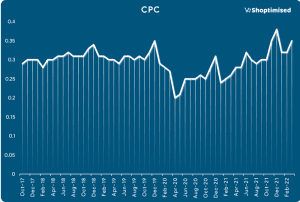
Cost per Clicks so far during March 2022 are at their 3rd highest level since we started recording in October 2017. The current Cost per Click is on par with peak trading months (November & December).
Whilst CPCs dropped earlier in the Pandemic, they spiked in November and December 2021 as expected, but the spike so far in March is not common.
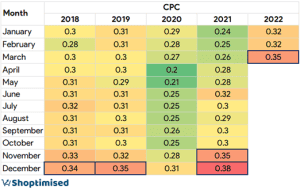
When we break down Shopping Sub-Types and compare March against December 2019, we can see Smart Shopping and Performance Max have reduced but Standard Shopping has increased.
One question that is difficult to answer is whether this is due to manual intervention within Standard Shopping where CPCs can be controlled or is this happening as a result of automation from Smart and/or P.Max?

To understand this better we needed to know how many Standard Shopping campaigns are truly under manual management compared to how many are letting Google’s Target ROAS or Maximize Clicks assign the bids or Enhanced CPC to a lesser degree.

Whilst Manual CPC is increasing, the largest CPCs are being driven from having Target ROAS set up within Standard Shopping campaigns.
Percentage of Spend Via Each Target Setting Within Standard Shopping

Despite it reducing, the majority of budget is still being spent on Target ROAS Standard Shopping campaigns. Based on these figures, it does appear that automation is playing a very large part in the rapid increase of CPCs.
Budgets are still at very high levels with many trying to increase them further. One of the major draw backs with Google's automation is when trying to scale and increase your budget. If you try and increase your budget too much and too quickly, Google quickly spends that budget with greatly inflated CPCs. If your plan is to increase budget, do this gradually with smaller increments whilst ensuring the CPC is not spiking.
In January 2022, the cost of living hit a 30 year high. Energy, fuel and food prices surged by 5.5% in the 12 months up until January and are expected to climb above 7% this year with some fearing that figure could move above 8.5%. With average pay not able to keep up with the rate inflation is increasing this inevitably means, consumers have less to spend. With further increases to come, this will only get harder.
Putting aside the tragic & completely unjustified loss of life that Russia's war on Ukraine is causing, it's also worsening the rise of the cost of living situation according to a report by the Resolution Foundation. "The crisis in Ukraine has increased both the scale of price rises, but also the degree of uncertainty about their levels and duration".
The increased costs for energy, fuel and transport mean retailers are increasing their prices and passing that onto consumers. UK retailer Next, has already stated that it’s prices may have to increase by up to 6% to keep pace with increasing costs.
With the rising cost of living, we are now seeing a drop in demand especially within Fast Moving Consumers Goods. As consumers continue to tighten their belts ahead of uncertain times, consumer buying will be prioritised by ‘needs’ rather than ‘wants’. This issue is further compounded by the increased competition and advertising costs.
This is having a sharp impact on ROAS in Google Shopping campaigns already. ROAS has now dropped to levels not seen since February 2019 again further highlighting a return to normal whilst spend this month is set to be on par with November 2020.
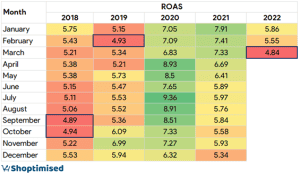
Many Google Shopping advertisers are seeing a stark drop in both revenue and spend due to their campaigns still containing higher ROAS Targets.
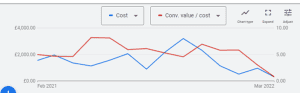
Whilst Revenue and Cost can be addressed by removing or lowering the campaigns Target ROAS, it won’t bring back the ROAS these campaigns were previously enjoying. Setting a Target ROAS or continuing to use a Target ROAS that is no longer achievable simply limits the amount of products Google will aim to push into Shopping Ads.
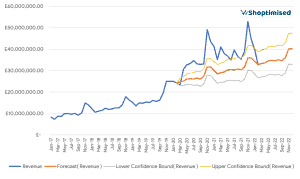
Our Technical Director plotted where we would have seen growth in ecommerce if the Pandemic did not occur. As you can see, we are now back towards those levels with new challenges to face.
The Orange line below is a forecast using averages and does not factor seasonality. But, at 95% confidence intervals, we expect 95% of the time we should be in between these two thinner grey and yellow lines. This graph shows that once the pandemic took hold, confidence initially dropped to the lower confidence interval in terms of spend, then it increased with people spending more money than anticipated. We are on the decline now and we can expect to drop to where we would have been should the Pandemic have not taken place.
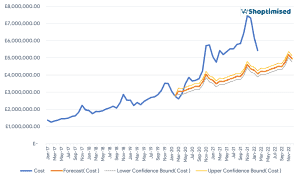
We can see consumers increased their online purchasing during the pandemic, with a few notable drops in October 2021, potentially waiting for Black Friday sales.
Looking back its absurd to think that every month during the pandemic was ahead of Nov 2019 in terms of revenue. Also, a possible worrying trend is that cost still has not regressed to the mean average, yet revenue has. With the increased CPC and drop in demand, ROAS is suffering across the board.
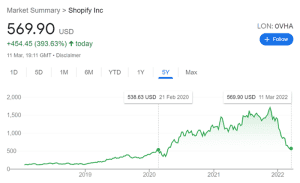
The Shares of ecommerce giant Shopify are showing an incredibly similar trend to the above further displaying that demand is at least where it was in February 2020 whilst we continue to face a very unpredictable 2022.
We asked the experts from several leading agencies about their thoughts and advice on the current climate.
1 - What are the biggest challenges in Google Ads at the moment?
Google is moving more and more towards full automation, from the continued improvement of Smart Bidding and Responsive Search ads, all the way through to fully automated campaigns like Smart Shopping (RIP) and Performance Max.
The real challenge is using these tools, alongside anything else in your arsenal, to differentiate yourself from the competition. If everyone is using fully automated campaigns - how do you stand out and drive the best possible performance?
2 - Why do you think Cost per Click is so high right now?
The world is opening up following the pandemic, which is causing a few different changes. There’s less search demand - we’re not all stuck inside any more which means that there’s more time spent socialising and less time spent in front of a screen, therefore less users engaging online. In addition to this, while most of us worked from home during the pandemic, there is a notable move to get people back into offices. This means less time avoiding work by browsing and shopping online, and more time focusing on your actual job.
This decrease in demand, combined with the fantastic results that a lot of online retailers saw during the pandemic (and wanting to match this performance, or drive growth), means that everyone wants the same size slice from an ever-decreasing pie. This means that competition is fiercer, driving up costs for everyone.
The cynic in me also believes that some of this inflation is artificial, based on a lot of changes to the machine learning based systems that Google is leaning so heavily on. If users aren’t leveraging these tools correctly, it could mean higher costs for everyone.
3 - What advice would you give your client’s considering demand is low and costs are high?
Considering demand is low and costs are high, clients need to understand exactly what PPC is worth to them. PPC should not be a loss-making exercise (unless that’s been factored into your overall business strategy) - you should understand exactly what a conversion (and therefore a click or view) is worth to the business, and optimise accordingly. Based on this, you may be able to bid more aggressively on certain keyword sets, or you may look at investing in another channel or campaign type such as Discovery or YouTube - but first of all, you need to understand the value that PPC and these other channels can provide.
4 - What is your top practical tip to improve performance in the current climate?
Ensure that you have full visibility of your performance across the board. This could mean different things to different people, but if you work with an agency, I would be challenging them on the visibility that you have. This could be anything from ensuring you’ve got a live reporting dashboard built out, or understanding brand performance versus non-brand, all the way to value-based bidding, and passing back actual revenue values into machine learning - there will always be another step on the journey to gaining full clarity.
1 - What are the biggest challenges with Google Ads at the moment?
Cookie and privacy policy updates mean we’re potentially losing visibility on many customers' user and conversion journeys.
2 - Why do you think Cost per Click is so high right now?
Increased online competition YoY as the pandemic has shifted more businesses marketing budgets to digital. Combined with automated bidding (whether this is aiming for traffic or conversions) marketers are losing more control over CPC's and the market is becoming more saturated.
In the first half of 2021, there were almost 80 new businesses created every hour, again, showcasing the trend of new, increasing competition in the marketplace.
3 - What advice would you give your client’s considering demand is low and costs are high?
Ensure your account is continuously testing assets and settings you can still control to really maximise budget efficiency.
Keeping budgets and marketing plans fluid during times of uncertainty. We’d recommend assessing areas where you’re seeing strong demand/results and allocate more budget there, e.g. certain product categories or locations. Monitoring of spend and performance should be frequent to make really agile decisions in the market as the market and demand trends change.
4 - What is your top practical tip to improve performance in the current climate?
Give campaigns the most data you can to feed the bidding algorithms. Granular segmentation is out and consolidation is in!
1 - What are the biggest challenges Google Ads at the moment?
One of the biggest challenges is the constant updates and changes to Google Ads – making it challenging for PPC professionals and their clients to keep up with the latest trends and best practices. Tracking is one of the things that is going to be changing, and the way we’re used to operating when it comes to tracking will be taken away and replaced by another method. In addition to these changes, rising CPCs are doing so in line with an increase in aggression across multiple markets. As a business, we’ve not been hugely impacted by this yet, but we’ve definitely seen evidence of it across the board, and we’re prepared for if it does start to affect us more in the future.
2 – Why do you think Cost per Click is so high right now?
Businesses, understandably, are desperate to increase sales to remain profitable, so when faced with high CPCs, are pushing aggression to drive sales. Many businesses will also be looking at performance from this time last year and comparing figures to try and match numbers, but forget that we were in the midst of a lockdown, and both businesses and consumers were operating differently.
3 - What advice would you give your client’s considering demand is low and costs are high?
A - Remember that this time last year, we were in a lockdown, so there’s no way to compare account performance like for like to last year. Businesses were doing whatever they could to survive, and consumers were spending completely differently – so there’s no way to compare the two fairly or accurately.
B - There’s been huge increases to both the cost of living, and energy and fuel prices, which has had a big impact on the way people are spending. Many people don’t have the same amounts of disposable income to spend on wants as opposed to needs.
C - Neither of the above spell out good news for businesses, but it’s important to look at alternate avenues and channels in order to stay profitable. Whilst PPC is a huge channel, right now, it might not be the best performer, and businesses can also look at how they could improve their other channels.
4 – What is your top practical tip to improve performance in the current climate?
It’s important to remain agile when it comes to your strategy. This isn’t just important internally, but it’s also important that your PPC agency are just as agile and on the same page. If something isn’t working, don’t take too long to make a decision on it, and likewise, if something is working, don’t take too long to double down on it!
1 - What are the biggest challenges Google Ads at the moment?
I’d say there are two main challenges at the moment, firstly the staggering increases in the cost of clicks year on year are putting significant pressure on advertisers. Secondly, the rapid adoption of automation has turned best practices on their head. To keep up brands and agencies are having to rapidly evolve their best practices with the ever-changing landscape to keep ahead.
2 - Why do you think the Cost per Click is so high right now?
I’d say the main reasons for this are twofold. An increase in competition with businesses moving from bricks and mortar to online due to the pandemic and secondly from the expansion of match types increasing the levels of competition in auctions. Previously advertisers had a lot of control over the queries that they matched into. With the broadening of match types, advertisers are entering more auctions than ever before, pushing up the prices of clicks.
3 - What advice would you give your client’s considering demand is low and costs are high?
I’d say brands need to be realistic, ensuring that the factor in the hike in costs into their projections firstly so there are no nasty surprises when they come to review performance later in the year. Keeping a close eye on stock will also be key to making sure they don’t over order anticipating a stellar year like 2021 and ending up with a lot of stock that can’t be sold.
4 - What is your top practical tip to improve performance in the current climate?
With CPCs on the rise, it’s going to be really important to cut our wasted spend. There are a few ways that this can be done, firstly looking at what you’re matching into and making sure it’s relevant by adding negative keywords is a great start and often overlooked. Another strategy is to focus your budgets on top performers, making sure that where you are paying more for clicks you’ve got the best chance of converting that traffic.
1 - What are the biggest challenges Google Ads at the moment?
The biggest challenge facing a lot of marketers recently is the ongoing decline in consumer confidence. With concerns regarding the economy, searchers are becoming more vigilant with their finances which subsequently, is impacting conversion rate and average order value metrics across Google Ads accounts.
Google is also making changes internally with the sunsetting of GA3 and Smart Shopping campaigns, the latter of which will be 'upgraded' to Performance Max later this year. As this new campaign type will hold dominance over the existing campaign types, any areas of strong performance obtains a risk of being cannibalised by PMax as it incorporates targeting across a broader range of channels. Our testing has shown this to be the case, with impressions plummeting across accounts following activation.
2 - Why do you think Cost per Click is so high right now?
During the pandemic, a lot of businesses who had previously maintained a minimal budget towards Google Ads capitalised on the traffic surge that occurred across various lockdowns. Even post lockdown, shoppers have become accustomed to online shopping, maintaining a larger pool of potential customers for advertisers. As the additional competition has sustained it's online presence, gaining strong ad visibility and positions has become costlier. This is also reflected in marketplace platforms such as 'Amazon' and 'Etsy', making their already intimidating impression share even more significant with their consistent growth of online sellers.
3 - What advice would you give your client’s considering demand is low and costs are high?
I'd recommend looking at the bigger picture. Setting aside budget now for use in Discovery Ads or Display Ads can result in a larger pool of potential prospects/customers later on. If budget is strained, try restricting campaigns to solely target relevant in-market audiences so your ad spend is focussed on users who have shown recent intent to purchase.
4 - What is your top practical tip to improve performance in the current climate?
Path journeys are longer than ever as users have become more 'tech savvy' across the pandemic and are more cautious with their purchases, so ensure you have campaigns dedicated for each stage of the sales funnel to accommodate the varied levels of search intent. By ignoring the early or mid-stages of your customers buying journey, you risk losing them to a competitor who hasn't. Closely monitor the impact of campaigns dedicated to the 'awareness' stage to ensure they're contributing to other campaigns/marketing channels effectively. And if they aren't, test, test and test again.
1 - What are the biggest challenges Google Ads at the moment?
We see two main challenges via search currently. Volatility feels like it’s at an all time high. This is in terms of demand, what competitors are doing and how the platform behaves in general.
Alongside this it is harder than ever to understand the changing search landscape. Multiple Google ‘features’ are promoting a lack of visibility:
2 - Why do you think Cost per Click is so high right now?
We see two main factors contributing to high CPCs.
In general retailers are all setting their sights and targets fairly high - many would’ve been in a position over the lockdown periods where they had record high demand but more challenges than ever when it comes to fulfilment. Whilst most marketers are targeting below the lockdown peaks - they are still under-pressure to drive sales far above what they have seen pre lockdown 2020. Where demand has dipped and meant these targets aren’t being reached we have seen retailers happy to sacrifice efficiencies and push marketing spends alongside this - it feels like many retailers are in a similar position leading to significant increases in competition and CPC.
The other factor is due to the continuing changes to Google Ads taking away control from marketers and promoting broad reaching automated campaigns. There is no longer much value in having extremely well targeted Exact Match campaigns using negatives to cut out inefficient search terms. This shift towards broad targeting and leaning on smart bidding means that overlaps between retailers in terms of what search terms they are bidding on is massively increased. We see YoY more and more less relevant competitors appearing alongside our clients via competitor insights - overall these overlaps will also be pushing CPCs.
3 - What advice would you give your clients considering demand is low and costs are high?
If we are looking at Cost as simply CPC, it can be a little misleading to look at CPC change as an indicator that marketing activity is struggling. As much as the space is more competitive, Google Ads has generally got better at driving conversions through smart bidding - where across our clients we generally do see CVR improvements for Generic and Shopping activity.
Beyond that we’re finding it extremely useful to remain flexible in what activity is targeting - where the best way to manage volatility (which is bound to continue) is to be reactive with budgets and accept over/under-pacing on single months.
4 - What is your top practical tip to improve performance in the current climate?
Play ball with Google recommendations. Quality score is seemingly becoming less important than opti score - it seems actively beneficial to have a high opti score even if some of the changes to get there seem counter-productive. For example things like avoiding pinning RSAs we see drive great results - despite the ads that google will serve being a lot less cohesive than pinned ads - there's a general sense that Google just prefers accounts with high opti score. In addition to this opti score is being used more as grounds for beta participation - where 90% is often required on current Google product betas.
1 - What are the biggest challenges with Google Ads at the moment?
At the moment the biggest challenge that we are experiencing on Google ads is an overall increase in competition and particularly a lack of ability to exercise competitive advantages in our strategy. It feels as though many of our competitors are now employing best practices in Google ads that our agency were early adopters to: Feed Optimisation with Shoptimised, CSS, Smart Target ROAS Bidding, and a Broad keyword strategy. As an agency we were very quick at recognising and adapting to these strategic advantages and drove real growth for our clients in 2020 and 2021 but it now feels that a lot more competitors are now employing these best practices, making it harder for the benefits of working with a premium Google ads agency to enunciate.
2 - Why do you think Cost per Click is so high right now?
I think we are experiencing a myriad of forces affecting the current Google ads market. In addition to lower online demand and lower consumer confidence in the light of rising energy prices and uncertainty in Eastern Europe, 2020-21 saw a record number of new businesses open in the UK. Furthermore, as previously mentioned, I think we are seeing more and more people applying Google best practices which is making Google ads targeting more efficient overall, which is driving the costs up for those of us that have been applying the same best practices over a longer term.
3 - What advice would you give your clients considering demand is low and costs are high?
From looking at the sort of clients that have recently been coming to Push for support in these tough times, we notice a theme that many are under-diversified and static in their digital strategies. It has become clear that selling the same products, through the same channels with the same marketing strategies is not going to be enough to grow your business in the next year. What worked last year is not going to work this year! This is most obvious when we look at the overall revenues of Facebook growing while the platform itself saw a decrease in monthly active users. Clearly advertisers' response to reduced sales has been to increase their ad spend on Facebook, while Facebook users themselves are moving elsewhere. Instead of relying on what has worked in the past, successful businesses will innovate and diversify their product portfolios and generate intent based search demand though top of funnel marketing on high growth platforms like YouTube and TikTok. More and more consumer time is being spent on video, and video is the biggest opportunity for good marketing agencies to enunciate their competencies. Video is an area that Push have been developing over the last year and with the growth of Video first platforms we definitely see video as being the most important growth area for our clients this year.
4 - What is your top practical tip to improve performance in the current climate?
Aside from what we've already discussed, two great areas to focus on improving are conversion rates and customer values as these two metrics will mitigate against negative market conditions and, when the market starts to look more positive, will help clients to maximise their gains.
1 - What are the biggest challenges with Google Ads at the moment?
From an advertiser’s perspective, the last couple of years have been a whirlwind - from Covid blowing YoY trend data out of the water, consumer buying habits fluctuating on a monthly basis and Google implementing a wealth of new campaign formats, It has meant that agencies have had to pivot strategies on a more regular basis than before.
I would also argue however (anecdotally perhaps!) that these challenges may not necessarily just be felt from an agency perspective. With Google facing industry backlash over the last year around data visibility (for example around a lack of data insights into performance max as well as search term visibility in general), there has been a greater cause for advertisers to diversify their paid media advertising, meaning that Google may be seeing some advertisers reduce spend on the platform.
2 - Why do you think Cost per Click is so high right now?
There are a number of reasons as to why CPC may be rising but without a shadow of a doubt COVID plays a large role in that. As mentioned, with almost monthly fluctuations in buyer habits, this would undoubtedly have an impact upon CPC’s and wider auction competition. However, in general COVID has left many businesses looking at their digital marketing efforts and in particular where they can maximise revenue - with search typically offering a fantastic way of driving up revenue figures. As a result, I would argue that as we see auctions begin to mature again, we may see CPC’s fall, but as things stand most industries are seeing spikes in competition and as such, higher CPC’s.
Thinking from an external perspective, it is also important to take into account wider economic circumstances. With cost of living increasing and individuals having to cut back spending, this will obviously in turn impact both search volumes and subsequently CPC’s.
I believe one thing businesses have to be wary of is not necessarily chasing 2020 revenue figures (which in some instances rose exponentially) with a reduced demand (taking into account the above examples).
3 - What advice would you give your clients considering demand is low and costs are high?
Transparency! It’s so crucial in times such as these to ensure that all paid advertising has clear goals and focuses and that there is clear visibility on what is and isn’t performing well. On a call with one of my clients the other day, he asked the question ‘well what’s working and what isn’t?’ and as simplistic as it may seem, this is the crux of what is important!
With costs rising and demand becoming more competitive, transparency around benchmarks have never been more crucial as well thought out KPI’s can help to ensure campaigns remain successful even during difficult times.
If businesses can be clear, transparent and open with benchmarks and targets,this allows agencies to push those key strategic drivers further - meaning we can both see better returns.
4 - What is your top practical tip to improve performance in the current climate?
As simple as it sounds, ensure that the basics are as good as they can be! No matter how many shifts we see in what is required of advertisers, the foundations largely remain the same and as important as ever. Continue testing ad quality, match types and audiences. Ensure all extensions are covered and that ads are directing users to the most relevant page. If quality scores remain strong then it always ensures that you’re competitive.
A huge challenge in Google Ads is the confluence of hypercompetition, volatile demand, and full automation. And that’s likely as true for the next 18 months as it has been for the last 18 months.
On the supply side, the technical barriers to ecommerce and acquisition have never been lower, which is helping to support a rise in entrepreneurship even as juggernauts continue concentrating markets. The result is a big squeeze, which is driving overall customer acquisition costs and unit metrics like CPC and CPM.
Meanwhile, on the demand side, we see online growth slowing as pandemic-related policies have relaxed in many markets and mobility in turn approaches pre-pandemic levels. Add recent inflation woes to the picture, and you can readily imagine why consumer volume and intent are shaky – which can be reflected in challenging conversion rates and average order values.
Some advertisers then feel caught in a situation where highly automated campaigns are most likely to deliver raw performance, yet hardest to steer in terms of true ROI – not to be confused with ROAS. My most practical and widely-applicable advice here is to cut the knot by tracking gross profit instead of revenue. This step eliminates guesswork and delivers a solid, safe growth foundation upon which you can experiment. If implementation is too challenging, a quick win would be to structure your campaigns based on margin. Generally I love the practice of bringing traditionally off-channel data into your feed and campaigns.
Firstly, we must accept the situation as it is. A unique set of circumstances have converged to create a perfect storm that none of us can control.
Reassess your KPIs and Target ROAS. This may mean you can increase revenue whilst accepting less profit. However, not every product you sell has the same margin. Grouping hundreds or thousands of products under the same Shopping Campaign with one Target ROAS is going to hold you back.
You need understand your margins better and pass this data back to Google Shopping by utilising the Cost of Goods Sold attribute in your product feeds. You can then lower your Target ROAS on your higher margin products.
Watch the market more closely, are you still price competitive or are your competitors discounting already? You may need to utilise price comparison data more regularly in order to achieve this.
Discount tactically, don’t throw around blanket discounts. Make sure you have enough margin in your products or that your promotions focus on increasing the basket size such as buy one, get X% off the 2nd or 3rd product purchased.
Try not to panic, it’s easier said then done we know! If you have been working with an in-house marketer or an agency for a while and things quickly take a turn for the worst, have confidence this is not their doing and that they are best placed to help you move forward.
Don’t over optimise. Every optimisation takes time and quite often it can go a little bit backwards before it starts to go forwards. If you over optimise when the market is shifting quickly, you can just make things worse.
Consider all Shopping Campaign Types, P.Max, Smart (at least until September!) and Standard Shopping. Whilst Google’s automated campaign types P.Max and Smart Shopping have delivered great results throughout the pandemic. Remember, that they automated and data-driven. Quick changes to buying habits can cause these campaigns to suffer until they can better understand and quantify the data.
Note: The data in the reports within this article are aggregated from 2,179 Google Ads accounts and they were correct at time of publishing: 24/03/2022

